All Stars
Honus Wagner called baseball “Organized Humiliation.” I have a hard time watching anyone, especially little kids, get humiliated, but there I was, standing on a grassy hill in the Arizona summer heat, watching just that. I stood next to Ed, my friend and assistant coach. We watched as a ten-year-old from the Ahwatukee All-Star team launched another frozen rope deep into right center. Runners sprinted around the bases while our ten-year-old outfielders chased after the ball. The score was fifteen to zip.
Now, technically speaking these weren’t our kids. Ed’s son and mine were too young for All Stars. But we came out to watch our neighborhood team, the boys of Tempe South Little League, compete for the district championship.1 And as I indicated, it was not fun to watch. The kids from across the freeway were destroying our kids. I looked closely at the Ahwatukee players. They didn’t look any bigger than our kids. Every kid on that field was ten years old! If they swapped uniforms for school clothes and hopped in a school bus, you couldn’t tell them apart.
But the boys from Ahwatukee hit like giants. Worse than that.
They looked more talented than our kids.
And that, hurt.
“How are they hitting like that?” I asked a little too loud. It didn’t seem fair.
“They hit,” Ed replied.
I gave him a flat look. “I can see that. But how?”
He turned to look at me. “They hit.” He paused. “A lot.”
It took me a moment for that to sink in, and it sat uneasily. This whole time I had been thinking these kids were somehow more gifted, more skilled, more talented. But what if their prodigious hitting was not the result of God-given talent, but something more mundane? What if… what I was seeing was the result of good, old fashioned work?
Could it be that simple?
Fall Ball
I knew Matt was a good player, possibly one of the best in the league2, but I did not want him to have the experience I saw those 10 year olds having. If we were going to get a different outcome we would have to do things differently. How could I put Ed’s idea to the test? Could I get the boys to hit, a lot? We had done a lot of batting practice during the Little League season, and it clearly wasn’t enough. I realized there was really only one way. I would have to assemble a team that played baseball year round. I asked Matt if he wanted to play year round and he did. I talked to Ed. He and his son Teddy were in. Recruiting ten more players and parents took some effort, but we pulled it together.
I started to work on a hitting program.
And when I say “working on a program,” I literally meant, working on a program. I didn’t just want to see our kids get on base more often, I wanted to see them do what the kids from Ahwatukee did to Tempe South. I wanted to see outfielders’ backs racing away from me as they tracked down balls hit over their heads.
Tee work
I started the players by hitting off a tee. I would put a ball on the tee and ask them to hit it. I figured, if a player couldn’t hit the ball when it was sitting still, how was he going to hit it when it was curving through the air?
The first kid in the box was Chipper.3 He strode up to the tee, and I told him, “Just hit a line drive.”
“A line drive, coach?”
“Yeah, you know, like flat off the tee,” I said.
Chipper carefully pulled back, and then carefully brought his bat around until the barrel hit the ball and it sort of limped off the tee in a weak impersonation of a line drive. I looked at the ball, and then at Chipper. What the hell was that!? Out loud I said, “Try to hit it a little harder.”
Over the course of the drill, I discovered what a paradox it is to hit a baseball. To paraphrase the Great Ted Williams, you want to hit a round ball with a round bat squarely. When the kids tried to control their swings, they were careful. When they swung hard, they were out of control. We needed them to be precise and fast.
How was I going to teach them to do that?
But that was not the only problem. Hammer walked in, gave me a nod, then reared back and took an enormous hack, and ripped the plastic tee to shreds. I mean the thing practically exploded when he hit it. He was ten.
He looked at me and with a sheepish grin said, “Sorry, coach.”
“Don’t worry about it,” I said, still looking at the fractured black tee. “You just keep swinging hard.”
The kids were careful with their swings not only because they wanted to hit the ball well. They didn’t want to get in trouble for breaking the equipment.
I was determined to help them solve this problem. I also decided to make my own tees. Some rubber sheets from Home Depot rolled into a cone, duct taped to pipes bolted to a board the size of home plate, and we were good to go. What’s more, we were better than good, because this tee would flip out of the way when the bat clipped it. The big cheap hard rubber tees from the sporting goods stores discouraged good hitting. Well, the kind of hitting I wanted to teach. And besides, the rubber sheets and duct tape were cheap and easy to replace. Great hitting, in contrast, was priceless.
Fast Bat Beats Fat Bat
I knew a lot of parents bought bats way too big and heavy for their kids. And I get it. You think hitting a baseball with a sledgehammer would be the best way to crush a baseball. It is if you’re trying to smash a ball on an anvil. But to launch a ball in the air, how fast you can swing the bat matters a lot more than how heavy the bat is. Force equals mass times acceleration, and acceleration changes with the square of velocity.
You probably learned the math in middle or high school then immediately forgot it.
Where is Force and is mass times acceleration, but few people know how to think about acceleration, but people understand velocity. Converting the force equation into kinetic energy reveals
So the energy of a swing is half the mass times the velocity squared. But who talks about kinetic energy except engineers and other nerds? So I would tell the kids and their parents Force equals mass times velocity squared. Not correct, but simple. Later I just said, “fast bat beats fat bat.” They knew what I meant. I wanted them to swing fast.
But what size bat was I talking about? I wanted bats proportional to a 10-year-old. Most pros are six feet two inches tall, weigh 207 pounds, and swing a 33- to 34-inch “drop three” bat.4 But a little leaguer is closer to four and a half feet tall.5 I looked for the shortest, lightest bat I could find. I zeroed in on a bat from Easton that was drop 12 and 27 inches long. It was expensive, but every kid could swing it and feel like they had control of their bat.
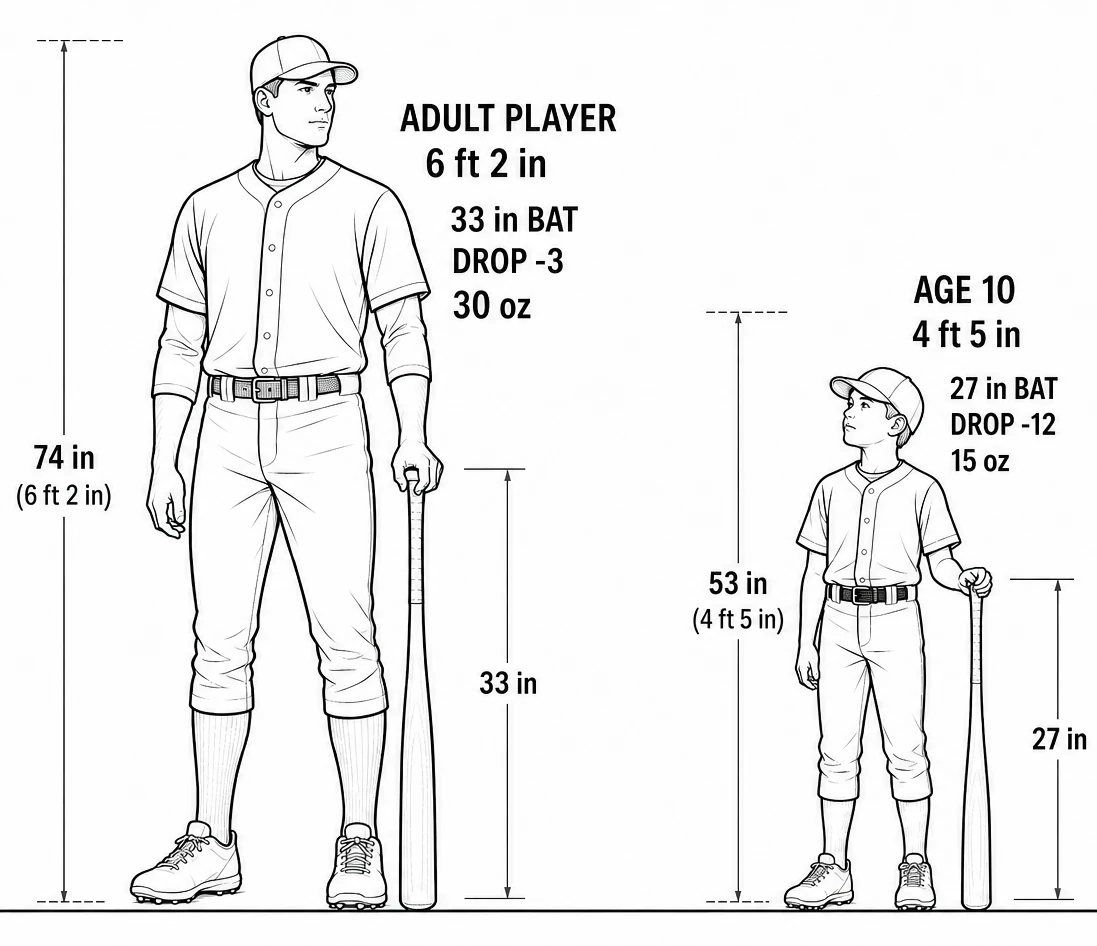
Armed with new bats, and new tees, we tried again. The results were night and day. With greater control they had greater accuracy. With greater accuracy, they had greater confidence. And with greater confidence they swung harder, a lot harder. Ball that used to barely brush the back of the net started punching deep into the black fabric. These little dudes were hitting, and hitting hard.
I set up a cage in my backyard and built two more tees. We set them up in the batting cage sideways, so three kids at a time could practice swinging. Then we added soft toss, then the pitching machine, and finally coach pitch. I wanted to get them as many swings as I could each practice. I wanted them to progress through speed, location, and variability. Every single drill built upon the last. You would have thought they got sick of it. But they didn’t. They loved it. They wanted more.
The Test
Our first real test came when I convinced the parents of our club team to play winter ball against an older age bracket. Ed and I felt the kids needed to face kid pitch if they were going to be ready for Little League, and the younger divisions were coach pitch. It was a risk, and I told the players and their parents we would probably not win any games, but that didn’t matter. What we needed was reps. I told the team we would track quality at-bats, not victories. At first, our players struggled to adjust. Hitting off a tee is one thing, but staring down another kid throwing at you? That can be intense.
But that was why we needed this. It was a rough start, and we lost most if not all of our games. But the kids hung in there. They kept improving, showing more confidence, taking better swings, making harder contact. You could feel the energy build, like a kettle ready to boil over. It happened at the Kyrene Middle School 8th-grade field. On a cold but sunny Saturday morning, Rocket stepped to the plate. He’d been hitting well, but not quite to his potential. All that was about to change.
He stood in the box, chewing bubble gum, and staring at the pitcher like he didn’t have a care in the world. He was relaxed. His bat wagged slow, lazy circles over his head. The kid on the mound was big. Bigger than Rocket. Bigger than our two smallest kids combined. But Rocket didn’t look nervous. He wanted a pitch to hit. He’d walked twice already. He wasn’t afraid. He was ready.
And then it happened. That big kid on the mound threw him a “challenge-me-fastball” right down the middle of the plate. Rocket got all of it. And I mean all of it. In a blur the barrel of his bat flashed to meet the ball dead center of the plate, and Rocket absolutely crushed that ball.
And that’s when I saw it.
Not the ball.
But the backs of the center and right fielders as they turned and ran after a ball hit way over their heads.
The Draft
When Little League season returned in the spring, all our boys tried out. We retired our club jerseys, and hoped for the best. But we needn’t have worried. Every boy got drafted, and most of them were selected in the early rounds where the good players get picked. Why? Because during the showcase, our kids stood out by hitting balls deep and hard. Every team needs offense. That group of players eventually went on to become the core of the Tempe South All-Star team. That hard work would eventually take them to the 10U championship.
But not beyond.
It turned out Ed was right. Hitters hit. A lot. And we proved that with our kids. But winning and performing under pressure required a different set of skills, ones I had not yet learned. I had solved hitting, but I had not solved baseball.
Footnotes
Footnotes
-
Little League of America runs a global tournament every summer that ends in Williamsport, PA. The tournament begins in the summer just like this, with district championships. ↩
-
I know every parent says that, but you know darn it, I really felt that way! Sue me. I’m a dad. ↩
-
We gave all the kids on the team nicknames. It’s a baseball tradition, a ton of fun, and solves the very real problem of having three Nicks on your team. ↩
-
“Drop” is a bat spec that folds length and weight into one number: drop = length (in inches) minus weight (in ounces), and it’s always negative for a bat lighter than its length in ounces. A 28-inch bat weighing 18 ounces has a drop of 28 − 18 = 10, written as -10. ↩
-
Most equipment manufacturers recommend bats 28–30 inches, 18–20 ounces (roughly a -10 drop). It seems to me they are more concerned with durability than functionality. ↩