The Power of Balance
Did you know that humans can not see combinations of Red and Green? According to opponent processing theory, our eyes are set up in a way that red and green are functionally in competition with each other. Why? To help us detect ripe fruit — ever wonder why the red apple pops up so often? It has a deep significance to our species. When enough red appears, we know the fruit is safe to eat. The green light is actually present but we can not hear it.
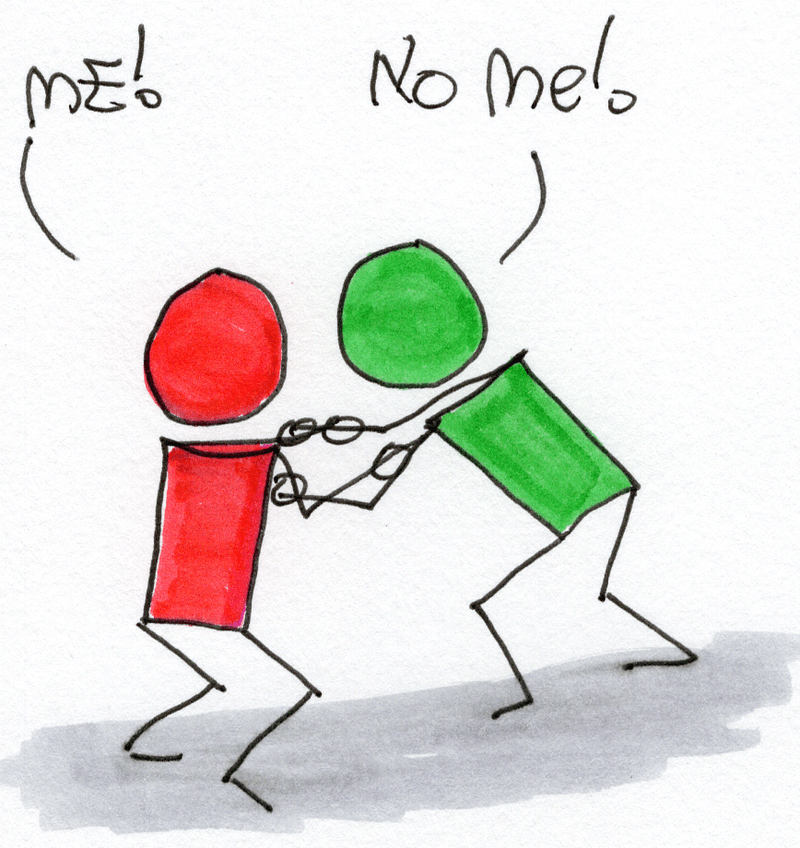
Opponent Processing Theory posits that humans can not see combinations of red and green light
I remember when I worked in Motorola’s research labs, we did a spectral analysis on a lemon. We were trying to figure out what wavelength of light “amber” was. It turns out we have no yellow receptor in our eyes and so people perceive yellow with a startlingly wide variation. But I digress.
The point is that our eyes evolved to detect ripe fruit through competition. It doesn’t end there. All mammals have bihemispheric brains. All of them. One half for routinization (left brain), one half tuned for novelty (right brain).
You will find this pattern of opposing systems throughout biology. It works.
What doesn’t work, and what gets us into trouble is when we have unopposed systems that have no balance.
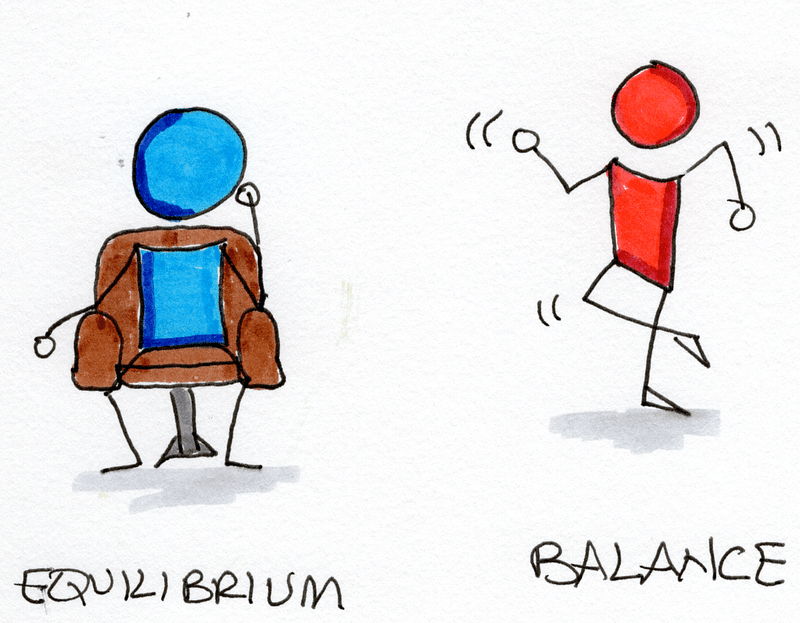
Equilibrium is not balance
When we are sitting in a chair, we often think we are balanced but we are not. We are experiencing equilibrium. Balance requires effort, opposition, forces in tension. Standing on one foot is balance. And it’s challenging. However, let’s say you needed to do some fine detail work with a brush or a pen. If you push one index finger against the one guiding the pen, your pen will suddenly become much more stable.
I give you all of these examples because we have gotten to a point where it seems we are afraid of competition. We want to win, to go undefeated, to breeze through problems with nary a bump. True, it is fun to experience flow, that feeling of unimpeded creativity and productivity. However, these states are rarely sustainable. And they are often brought about by… you guessed it, competition. Or perhaps I should, “matched opposition”.
Finding stability with competition
In his book, “Win Forever” Pete Carrol shares that competition is the basis for everything they do. They are always competing, in small ways and in big. He tells the story of having a tug of war at one of his first meetings with the Trojans, or of the time he made the coaches compete in a mudslide contest after practice. Always competing. His win record is impressive.
The two cornerstones of Wooden’s Pyramid of Success are Industriousness and Enthusiasm. Think about those two words. Hard work, and fun. Those two blocks anchor the pyramid.
It is clear that some of the winningest programs in the history of sports made competition an integral part of their player development process.
Inclusive Competition
However, most of us do not work in industries that require tremendous physical prowess to be successful. Knowledge work has thankfully expanded to be radically more inclusive and more diverse. This means however that to extract the maximum benefit of competition, we need to find ways to compete that focus on the real skills that matter in the workplace.
I hope you can see where this is going. I believe one of the most effective ways for us to bring workers together — especially remote workers — is through video game competition. Over the last 15 years of providing tens of thousands of corporate team building events, we have seen people of all four generations play and compete together. The tremendous advances of multiplayer online video games have made new models available.
Competition Can Be Creative
Here’s an example. Did you know you could take a non-combat game like Minecraft and hold a build-off? I think of Minecraft as a collaborative manifestation engine. This means we can not only be in the world together, but we can work together to create virtually anything we can imagine. By setting up teams that are given creative challenges like building a tree fort, this turns the idea of “winning” on its head. When people create together, whole new areas of communication are produced. What’s more, projects like this give teams the opportunity for unstructured interaction that can lead to a closer connection.
Interdependence and Competition
There are now whole games dedicated to interdependent teamwork. One of the most popular at the present moment is Among Us, a game where 8 out of 10 people are working to repair a broken space ship, but 2 people are sabotaging the effort. The key is to figure out who is who. Games Like Tools Up, Surgeon Simulator 2 (this one is intense), and Moving Out.
These games all feature frantic interdependent teamwork that will get your staff playing in ways they never imagined.
Traditional Competition
This is not to rule out the possibility of simply running a Madden Tournament, or NBA2K, or Fortnite. Straight-up winner-take-all style tournaments if run properly can also bring out the energy. The key is to make sure whatever you are doing, you have a stream and a focal point for people to congregate and mingle when they are not playing. There are a variety of ways to operate events like this that maximize participation and player interactions.
Virtual Esports Open
At its heart, this is what we have been doing with our virtual esports open. These events are managed by a professional tournament organizer, as well an experience broadcast commentator. The key is they take away the learning curve for the participants so they can focus on playing together, and the live stream makes these events fun to watch and participate in. The main advantage of working with professionals like Bravous two-fold: Peace of mind, and ease of implementation. We have done hundreds of events for tens of thousands of college students coast to coast.
Summary
Whether you do it yourself, or you have it done professionally for your time, with a company like Bravous, video games have become one of the most popular ways that people play together. This capacity to allow people of incredible diversity to compete as equals is probably the greatest potential of gaming. Because in my experience, the best teams are the ones that help each other get better.