How Connected Leadership Unlocks Team Resilience
I told a friend recently that “Pivot” is a hockey term. It is a euphemism for getting checked face-first into the boards.
You will stop.
You will change directions.
It will hurt.
In all seriousness, 2020 taught most of the people I know how to move quickly, think on their feet, and reimagine their businesses. I have the advantage of watching not one, but two companies maneuver through this stormy sea of change and it has taught me a few things about the power of vision and the value of Connected Leadership.
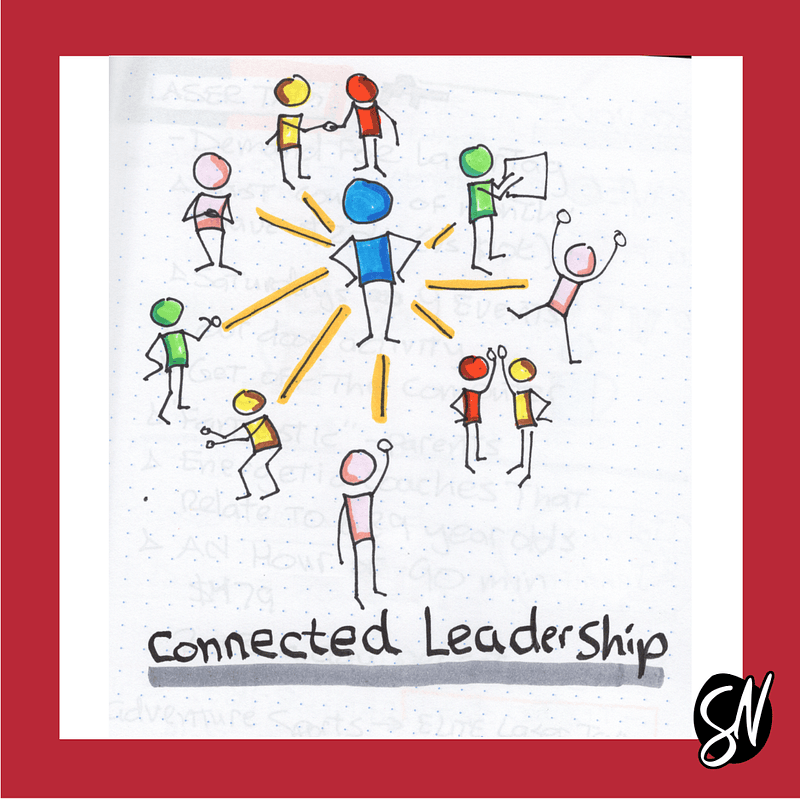
What’s Connected Leadership?
Connected Leadership puts human connection front and center in the management of the company. There is growing evidence that human bonding creates three fundamentally healthy psychological effects within humans. These effects are called the big R’s. They are:
1. Relatedness
2. Regulation
3. Resiliency
Relatedness has to do with how people relate to each other. Regulation is the regulation of emotion, and resiliency is our capacity to deal with uncertainty and change. Turning this around, who wants unrelatable, unstable, fragile people on their team or leading their company? Unfortunately, many leaders unwittingly create exactly these effects without understanding why or how.
The legendary Fred Rogers (Mr. Rogers) wanted his show to be a platform to help children handle their emotions. In the same vein, the Connected Leader strives to create an environment where adults are better able to manage their emotions in a mature, effective way.
Sound like magic?
It’s better than that. It’s science.
The Science of Psychological Safety
Author Dan Pink wrote, “There is a gap between what science knows and business practices.”
In his book Drive, Pink outlines the factors that create true, intrinsic motivation in individuals. Psychological Safety is the science of how motivation affects teams. As social animals, homo sapiens are powerfully affected by the environment and relationships we have with each other. Of all the mammals on the planet, only mankind has “whites of the eyes” (sclera). Why? It is theorized that when we developed as a species, we needed to know where someone else was looking. The “windows of our soul” speak to the powerful influence we each have over each other, mentally, and emotionally. These affects directly impact our feelings of motivation.
Most books on motivation focus on the individual. Psychological Safety, however, covers how motivation plays out in groups. Motivation it turns out is not something you give someone, but something you help them bring out of themselves. Internally generated motivation looks like engagement. Video game developers understand engagement very well. They are experts in it. The best games are engineered to maximize player engagement.
Not only is there a gap between what science knows and business practices, I believe there is also a gap between what video game developers know and businesses implement. Why? Because video games require action. You can not play without participating. This moves games out of the theoretical and into the practical. Business is all about application and execution. This is one of the reasons I believe we need to re:think games, specifically our attitudes and perspectives on game technology. Advanced technology that stimulates autonomous engaged action is extremely interesting.
Video games demonstrate that engagement is rooted in creating a generative environment where people can self-motivate. The way to do this is to start with Psychological Safety.
What Holds Us Back?
If you look at your own career, how important to you is it that you project an impression of smart competence to your boss and coworkers? If you’re a founder or CEO, then most likely you want your employees and customers to trust your intelligence and skill. Who wouldn’t?
Psychology tells us that not only is it important for others to see us this way, but it is equally important that we see ourselves this way. It is completely natural to want to have a positive self-image. Confidence and esteem are rooted in maintaining a healthy self-image. We have worked hard to become knowledgeable and competent.
What is the problem? Human nature makes it easier to avoid situations that threaten this image. Unfortunately, these are exactly the kinds of situations we need to grow and develop to our full potential. Put simply, most professional adults hate to learn in front of other people. This is why relationships with others are so important. When we are surrounded by people who know us and accept us for our authentic genuine selves, we have the freedom to take off our “impression armor” and adapt. Like a crab outgrowing a shell, people need to be able to shed their old image and grow a new one. This is a very vulnerable process and very few people like to do it. Science tells us we are much more likely to do it if we feel supported and accepted.
Just as the crab is vulnerable when it sheds its shell, professionals, no matter how tenured can also feel “naked” when they have to assume a new role or deal with change that makes it difficult for them to predict their performance. And yet these steps are absolutely essential for growth.
Many people get stuck because they do not perceive it is safe enough to remove their armor. Therefore instead of growing, they become detached, disengaged, and demotivated.
Put another way, it is easier to try and be the hero than to need a hero.
Self Leadership
This might all sound abstract, so allow me to share my experience from Bravous Esports. From the get-go, we designed Bravous to be a human connection business. We set out to maximize employee engagement. we believed no member of our team would treat a customer better than we treated them. therefore, we also strove to implement what we knew about psychological safety.
Asking for Help
This is one specific example of how Psychological Safety manifests itself at Bravous. We have many company-wide public communications channels in our chat app. Some are purely functional — like #General, #Tournament-Updates, and #Content-Team. Others are fun like #Random, and some are social glue, like #Wins-And-Gratitude. From my perspective as founder, however, my favorite channel is, #RaiseAHand.
Why?
Because every time someone uses that channel, I know we are about to improve as a company. We are learning and growing. And we are doing it in a public way.
We worked hard to develop a high degree of trust not only within our teams but across the organization as a whole.
Fast Learning Equals Better Results
Imagine you had a microphone to your entire company, and you could pick up and speak your most pressing problem into it. Would you do it? What would you think of someone who did use it?
I’m not talking about complaining, or whining, or rehashing old wounds. I’m talking about, “this is broken now and needs to be fixed ASAP.”
COVID kicked Bravous into a completely new line of business 8 months ago with barely 3 days’ notice. That’s what can happen when the entire country stops have events in person practically overnight. This meant we not only had to use new methods to deliver video game events, but we also had to develop new systems to manage those events and communicate with our customers.
There was zero chance we were going to get that right the first time out of the gate. What’s more, we did not have the time to prepare, plan, or strategize. We faced an adapt or die situation. We had no choice but to build the airplane while we were flying it. In order to keep that plane in the air, however, we needed a way to bubble problems to the surface fast and act on them.
It is a given that your people need to be good at identifying problems and solving problems — but are they as good as at asking for help? And when they ask for help, how is it delivered?
Our vision for how help is delivered came from a friend of mine, Dave Berg, who inspires his teams to “swarm problems.”
Now back to the microphone.
Would you use it?
We do. Here’s how.
For a short while, it got used daily, then weekly. #RaiseAHand Is still in use, but as the business matures, it is used quite as frequently. It all depends upon the rate of change and growth we are experiencing.
When someone posts to #RaiseAHand, their message has visibility across the entire company. From the founder (me) through to the newest team member. Everyone has access to these messages.
The response to these posts is always the same. Anyone, at any level who can help, does.
We have had partners use this channel, as well as Senior Managers, Tournament Organizers, and Customer Success Managers — almost everyone at one time or another has had an issue that they needed help solving. As a result, issues are squashed, not people. By identifying problems quickly and efficectively, we can make rapid progress. What’s more, problems are handled at the lowest possible level in the organization. This prevents senior people from becoming bottlenecks and the people closest to the work feel empowered to solve hard problems.
Yet those benefits are what makes #RaiseAHand so special to me.
What makes it special is that my people are willing to use it.
Ask for help is hard.
Asking for help, especially in a very public way can directly threaten that image of knowledge and competence we strive so hard to uphold.
In my experience, people will only take that risk if they feel safe.
The science supports my observation. Psychological Safety, according to Google’s Project Aristotle is one of the key ingredients in creating high functioning, self-leading teams.
Connection Leadership
Connected Leadership is about more than financial results, because sometimes, like in a crisis, goals get tossed out the window, and you are thrust into pathfinding mode. Chaos always brings both opportunity and threat. In a crisis, resilient adaptation allowed us to find the opportunity in the chaos.
If you want your team to have that kind of skill, they need to feel connected, they need to feel safe. And if you do those things, then when a crisis comes to pass your team will be able to open the door of intrinsic motivation in themselves. Engaged people tackle hard problems quickly and efficiently. According to Brene Brown, they are more creative, have more cognitive capacity, and produce more innovative solutions. Psychological Safety allows people to remove their impression armor, confident they can grow as individuals. This rapid learning unlocks their resiliency and adaptability.
This is how a diverse group of individuals reinvented our business in a matter of days, recruited more people to our team from across the country, and grew revenue 1,000% in the middle of a Pandemic. They somehow managed to do all of this without sacrificing our core mission of creating community engagement.
At Bravous Esports, our goal is to create events where players can make a friend. The role of the connected leader is similar. You strive to create an environment for your people where they can relate to each other better, and as a result, free their motivation.
In my experience, motivated, resilient teams are powerful. If that were not the case I would not be here to write about it.
#rethinkgames #leadershipdevelopment #teambuilding #connectedleadership #psycologicalsafety