How a Digital Second Brain Helps Me Defeat the Hedonic Treadmill
The Hedonic Treadmill is a concept first introduced by psychologists Brickman and Campbell in their 1971 paper titled “Hedonic Relativism and Planning the Good Society.” They famously studied lottery winners and found that while winners experienced momentary elation, they swiftly returned to a baseline level of happiness.
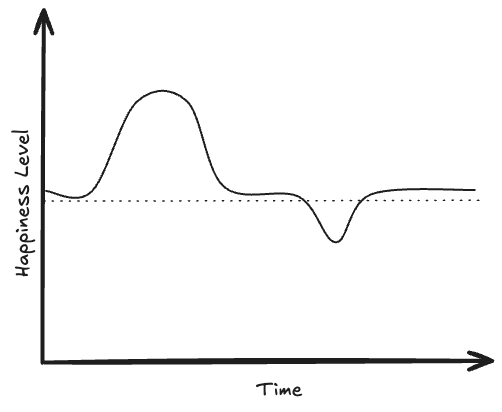
The graph is illustrative because it highlights how humans tend to be remarkably resilient to both good and bad external changes in our circumstances. As they say, “I’ve got good news and bad news.” As is my preference, what’s the bad news? (I prefer to end on a “good note”). The bad news is that when you achieve something, when you do something that makes you feel happy, you will, over time, return to your prior level of happiness. As the parable of the manic king tells us, when something positive happens, read the inscription on the “magic ring.” The words are, “This too shall pass.”
What is the good news? Well, the same news actually. This too shall pass. The graph shows that humans are remarkably resilient at recovering from setbacks.
Depression, loneliness, anxiety, and resentment are the Four Mental Horsemen of the modern era. I honestly do not know what to make of the recent elevation of mental illness as an all-pervasive, never-ending struggle rippling through our culture. Prior research indicated that humans were far more resilient than we seem to be today. It is hard to tell if this is an Availability Bias (because it is talked about more, it seems to be more prevalent). It could be that when this research was done in the 1970s, social media, smartphones, filter bubbles, outrage porn, fake news, and the attention economy did not yet exist. Personally, I think it is a bit of both: structural changes in how people interact (mediated exchanges using manipulative technology platforms) and how we think about our interactions are contributing to mental dis-ease. A loss of ease in how we think about and relate to others.
The Lesson
The lesson here comes back to something I talk with young men and their parents about all the time. Do not chase happiness. Happiness cannot be a “goal” because it is not a “state” that humans can achieve and hold onto for any length of time. The higher order goal is to pursue satisfaction. Wooden talked about something similar. The Wizard of Westwood, whose teams won an incredible 10 NCAA National Championships, did not define competitive excellence as “winning.” In fact, he said (wisely) that for some, winning is not enough. (During his tenure, he was often criticized for not winning “by enough points.” His wins, while unprecedented, were still not enough to satisfy the fans.) Nor did Wooden use the word happiness or passion when he described competitive excellence. He said:
“Success is peace of mind which is a direct result of self-satisfaction in knowing you did your best to become the best that you are capable of becoming.” - John Wooden
This focus on satisfaction is significant. In case you’re curious, the difference between happiness and satisfaction in this context matters.
Satisfaction is a deeper, more stable sense of contentment and fulfillment based upon an internal, self-generated sense of progress, whereas happiness is more fleeting, emotionally based, and often tied to positive external experiences.
But what does this have to do with having a digital second brain? Well, if you can’t be happy (it’s not a static state), what you can do is become happier. You can raise your baseline of happiness.
How?
From the book Thinking Graphs by Dolev Erez, he suggests several methods, but the two that are most relevant here are:
- Learn new skills
- Invest in relationships
Learn New Skills
According to Erez, you can elevate your baseline happiness level by shifting focus from achieving external event goals (like getting a promotion, buying a new car, or going on vacation) to focusing on internal growth and self-development goals.
Internal growth goals include things like continuously learning new skills, prioritizing family time, and increasing physical activity. These internal measures have been proven to enhance your baseline happiness level.
In business, we label all of this under the clumsy label “work-life balance,” as if work has nothing to do with life and life nothing to do with work. One of my favorite expressions is: at its best, work is love made visible. Work can be an integral expression of who we are and can contribute to our baseline of happiness. It is the obsession over external achievement that is misleading because it is seldom lasting.
Invest in Relationships
Erez also points out that you can increase your baseline of happiness by prioritizing meaningful relationships and connections. Investing time and energy in building and nurturing relationships with family, friends, and community can provide a more stable and enduring source of happiness.
How Does a Second Brain Help?
When I first talk to people about having a digital second brain, they are almost always focused on using the system to increase their personal productivity. In short, they see a Personal Knowledge System as a productivity enhancer. And it is that, but it is not only that. For me, a significant amount of its value comes not from being more productive, but from:
- Improving my capacity to learn new skills
- Helping me prioritize my relationships
Better Learning
Using the PARA system, I am able to organize and compartmentalize my curiosity. Using the Resources folder, any time I come across something I am curious about, I can create a new resource, add a home note, and start generating thought trains as I explore a topic in detail.
Take, for example, 3D printing. The idea that I can design and print my own toys, spaceships, whatever. You have to understand (well you don’t, but I’m pleading with you to understand) that I grew up in the Star Trek, Star Wars era where your access to toys was limited to what Hasbro and Mattel would produce. Today, I can now go to Thingiverse, download a model made by a fan, and print it. Or I can design my own (which I have).
All those details, all that learning about leveling the build plate, what kind of PLA to buy, how to build scaffolding, what settings to use, where to find the best models, what kind of modeling software to use, all of that is in my Vault/3 Resources/3D Printing folder, all saved in notes. At any moment in time, when I want to come back to printing, I can quickly scan these notes and get back up to speed in just a few minutes. It is like a little mental workshop ready and waiting for me to come play.
Since I fill the role of visionary in my company, I also have something like 20 other folders that contain projects I am exploring. At the same time, Richard Feynman encouraged people to always have “a dozen questions.” What are you interested in? Resources are meant for the future. You don’t know when you’re going to use them, but you can invest in learning about them now. Some of my Resource folders include:
- Automations
- Bible Study
- Cartoons
- EOS
- Fountain Pens
- Life Hacks
- Masculinity
- Maturity
- Motivational Interviewing
- One Bag Travel
- Skilled Helper
- Spanish
And many more. This framework becomes the scaffolding where I can organize, collect, and connect my new knowledge to prior learning and accelerate my ability to improve my skills. If you want a quick hack to skill acquisition, I recommend the book The First 20 Hours by Josh Kaufman. If you follow his methodology, you may find that having a digital second brain is the perfect tool to help you organize and track your efforts at intentional skill development. I know I did, and still do.
Invest in Relationships
As a culture, we are so obsessed with goal achievement that it can be a shock to realize that not everything responds well to goals. And being externally focused, goals tend to create temporary changes in happiness but rarely lasting changes. In contrast to SMART goals (Specific, Measurable, Actionable, Realistic, and Time-bound), I crafted HEART Roles. In this system, HEART stands for:
- Holistic
- Experiential
- Authentic
- Relational
- Timeless
And the part of my Digital Second Brain that helps me with this is the Areas folder. Inside Areas, I create subfolders like:
- Area - Father
- Area - Husband
- Area - CEO
- Area - Accountability Coach
While Areas can also reflect relationships I have with things (such as Area - Homeowner), for me, that always boils down to a role. And when you think of a role you play in life, the question becomes not so much what you want to achieve, but how do you want to show up? If all the world is a stage (Shakespeare), what part do you want to play, and how do you want to play it? This is different from goal orientation because it is about relationships.
I have a novel way of thinking about relationships. To me, a relationship is:
Let’s break it down. First, for there to be a relationship, both parties must acknowledge you are in one. And it must be voluntary. The appropriate care defines the boundaries of what behaviors are, well, appropriate for this relationship. And this is the part where I say, how do you want to show up? But also, relationships “die on the vine” if they are not cared for. They are organic, dynamic things that need care and tending.
The shared context, I realize, sounds abstract, but it is a real thing. When I coached youth baseball, I was very close with a number of other men who helped me coach. But when the coaching ended, the relationships did as well, not because of anger, animosity, or indifference, but because the shared context which made those relationships possible had dissolved. It went away.
This happens. Not all relationships are forever. (Some are). But what the Areas in my digital second brain help me to do is get crystal clear about what my HEART roles are going to be. How do I want to show up? How do I want to feel? How do I want other people to feel? What kinds of experiences are we going to share together? Can I be authentic? (Or what is the appropriate level of authenticity?) What is the context of this relationship? Family, friends, function? And finally, what is the time frame? I hope as a father, it never ends. As a volunteer coach for the Entrepreneurs Organization, I expect that to last exactly one year. What about CEO? Yeah, someday I’ll retire, but I don’t have a firm date on that.
It’s About People
In fact, neglecting to keep in close contact with people who are important to you is at least as dangerous to your health as a pack-a-day cigarette habit, hypertension, or obesity. - Susan Pinker
One other tip about having a digital second brain: I learned from my good friend Chris Roth. Chris keeps a database of his friends. He knows what they like, what their interests are, and what they like to do. It’s like his own personal version of Harvey Mackay’s 66 questions. But he does it because he cares. When he visits friends (he has friends all over the world), he can review his notes and then reach out with suggestions and ideas for what they could do when they get together. I love that about Chris, and I have stolen that idea and integrated it into my system with “PeopleCards.” These are my notes about the people in my life. I’m not as good as Chris at keeping them up to date, but every time I come back and find one and it helps me solve a people problem (what size shoes does my wife wear?), I am reminded of their utility.
Summary
My main point here is that my second brain does a lot more than “help me get stuff done.” Sure, it is a productivity tool. But it is also a powerful aid in helping me increase my baseline of happiness because it accelerates my personal improvement and skill building. More importantly, however, it gives me clarity on the important relationships in my life. That clarity helps me prioritize spending time and effort on the relationships that matter most in my life. And it frees me from turning them into goals. I do not need to generate some specific outcome with family or friends. Relationships don’t have to produce something. I don’t need to get something done. I just need to show up in a way that reflects my values and I’m already “successful.”
Whether you use PARA or a digital second brain is really beside the point. Coming up with a system to accelerate, retain, and improve your learning, I am convinced, will have a profound impact on your life satisfaction. Similarly, being intentional about your relationships will also have a significant impact on your long-term happiness and your health.
Whether you adopt a PARA methodology or you find some other tool to help, give these ideas a try. Find a better way to track and manage your learning, but most importantly, find a way to gain clarity on the important relationships in your life. Give that a try and let me know how that works for you. I’d love to hear it.