Coaching Esports: Be Process Focused
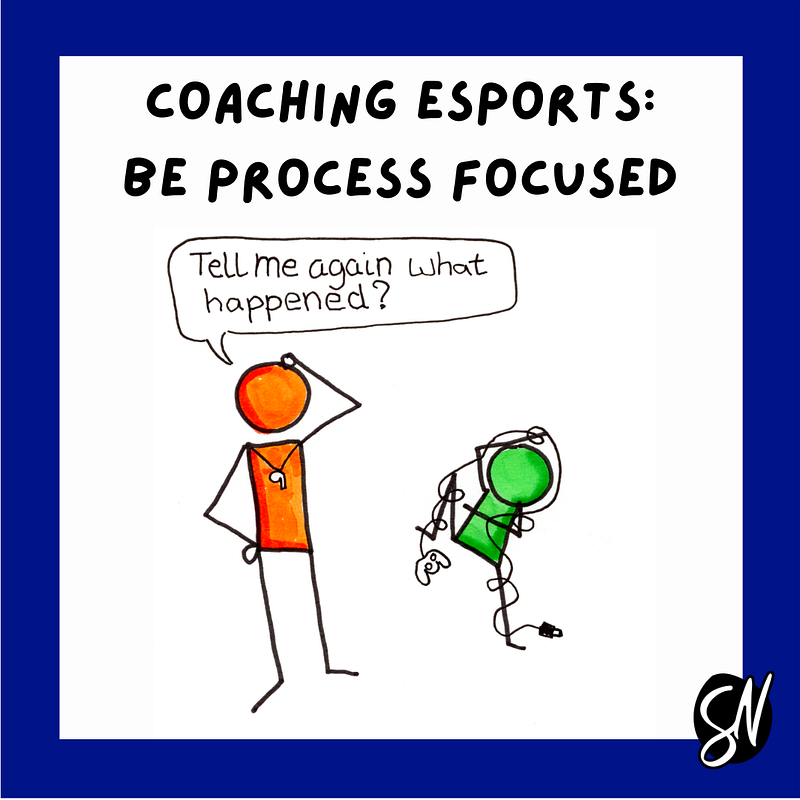
If you are thinking about starting and esports league, one of the most important things you can do is to help the kids improve. This kind of coaching is not only skills coaching, but also mentoring. The words, coach, mentor, and teacher get tossed around a lot. So let me give you some definitions that make sense to me. While a lot of the work feels similar, there are differences.
Here are my definitions. A teacher is someone tasked with educating a group of people to a prescribed standard. Teachers work is often measured by certifications, or standardized tests. A coach in contrast is someone who is trying to help a player grow to their maximum potential. There is no standardized test, although there should be a feeling of progression. Coaches have to deal with the reality that there are vast differences between players and what they know and what they may be able to do and is free to help different players differently. There is no standard test.
While some people could argue that winning is a form of standardized test, I no longer hold that point of view. For me, it is about the players and their progress. While video games may seem to be so structured and programmatic that coaching would be irrelevant, coaching is not only about physical skill. It is also about guidance, encouragement, and most importantly about the mental aspects of competition.
This still applies to video games. I see it all the time. Let’s take a look at what a coach can do, to help esport athletes improve.
How Kids Deal with Stress
While I was coaching little league, I saw a pattern repeat itself over and over again. Kids seemed to have two dominant modes of dealing with disappointment and frustration.
- They would get super angry.
- They would act like they didn’t care.
Both of these are defense mechanisms against emotional pain. The first almost seemed like an attempt to cut everyone off at the pass. The player would get so angry at themselves; it was almost scary. It was like they were trying to say, “Don’t you dare come and ask me about that bad play. I am so angry at myself you couldn’t possibly be any angrier.” Sadly, in a lot of sports, parents and coaches can get angrier but that seems to be the driving goal. Most of the time the coach or parent suddenly shifts into trying to calm down the player which only makes it worse. Why? Because the strategy is working. Everyone is distracted by the anger, not the mistake.
The second mode is one of not caring. When an avoidable mistake happens, young players often feign indifference. Their attitude and body language seems to be trying to say, “Well what did you expect? I wasn’t even trying. Had I tried I would have made that play, but since I didn’t, oh well.” There is this emotional distancing that comes from this attitude and again, it is a strategy for dealing with emotional pain. They can pile on by saying this game is stupid, or it doesn’t matter.
In my experience these two modes have a common root, the player is trying to cope with emotional pain and disappointment. Not only in themselves, but what they expect to get from parents and coaches. When everyone focuses on outcomes, and something doesn’t go as planned or as expected — hello emotional pain. I think we can all imagine the picture of the screaming coach, or the parent who has a tired when the kids don’t perform well.
Fortunately (or unfortunately) so few parents know what is going on in video games that these external causes of stress are relatively infrequent. What is common however, is the players actually sculpting their identity out of winning. It is not uncommon in esports to come across promising young players who are technically sound but emotionally fragile. They have shaped their skills through countless hours playing in isolation and they have culled or cut off challenges that reveal their weaknesses. Either consciously, or unconsciously they avoid situations that threaten their identity as a skilled player. They become their own “outcome coach” — berating themselves, or the world, or anyone else for their failure. They are protecting their identity at all costs.
Fortunately, these external pressures can be mitigated by shifting the players attention away from the outcome and onto the process.
Become Process Focused
The reality is that when we focus on outcomes, we often bundle into that things we do not control. And I have seen players with a bad approach, or awful skill get lucky and get a good outcome, or at higher levels, particularly good players do everything right and catch a bad break and receive a bad outcome for their efforts. What’s more I touched upon the individual players who eschew the kinds of challenges that could help them grow, so they can maintain their self-image as a “winner”.
An excessive focus on positive outcomes can reinforce three unhealthy habits:
- It can encourage bad habits because they do work sometimes.
- It can discourage good habits because nothing works 100% of the time.
- It can keep people stuck in their current level of skill.
My entire experience and skill as a coach changed dramatically when I shifted away from focusing on outcomes and started to focus on process or methods. There are three dimensions to being process focused.
First, you have to realize that a person is not defined by the outcome, but by the effort. This can create space for the player (and the coach and parent) between the person, and the results. I have had to use this personally as I recently had a presentation go horribly wrong. Was I a bad presenter because the audience had an unpleasant experience due to technical difficulties? Or was I a good presenter who got caught in an unpleasant situation created by some technical difficulties?
We have to be willing to extend grace to our players and reconfirm that it is their intent and their actions that define who they are, not the outcomes.
Second, we want to focus our attention, and the players attention, on what we can control. In regard to my presentation, I had allowed a part of the experience to depend upon something I could not control. For the next presentation, I eliminated that variable, and the event went very well, better than expected actually. I did not change, but the variables did.
Finally, there is a specific pattern and method for talking to players that makes all the difference.
The first two ideas are conceptual.
The player is not defined by the outcome.
The player needs to focus on what they can control.
The third element is practice. It is how we talk to players we are coaching.
Banish the Word Why from Your Vocabulary
So make the best of this test
And don’t ask why
It’s not a question
But a lesson learned in time
— Green Day Good Riddance (Time of Your Life)
I have learned over time to stop asking people “why?” This simple word, when asked as a question creates an immediate defensiveness on the part of the person being asked. What’s more, it positions the person asking as an adversary. Why seems to demand a justification, an answer, and it often is focused on the outcome. No matter how you package it, “why questions” almost also ask the respondent to justify whey something did, or did not happen. “Why did you misplay that ball?” or “Why didn’t you recover when Pikachu knocked you off the ledge?”
The most productive way to gather information is to ask the player open ended questions that are aimed at understanding the process. Try:
- What was happening for you?
- Tell me about that last play
- What as your process there?
Any variation of these will work. The goal is to create the opportunity for you to come alongside the player and stand in their shoes and see what they saw. What was happening for them? How did they read the situation? What was their decision process?
There are multiple benefits to this kind of questioning.
- It puts you on the same side of the table as the player. You are someone coming alongside them to help them.
- It can help them regulate emotion because they are not “in trouble”. You can remind them that good processes can sometimes produce bad outcomes, just like bad processes can sometimes produce good outcomes.
- You gain valuable information and insight that may help you know how to better help that player prepare in the future.
Finally, I have found that these questions also calmed me down.
Example exchange
- After coming off the field, I walked up to one my players and asked him, “Tell me about that ground ball. What was happening for you?”
- The player, a talented 11-year-old short stop said, “well, it took a wicked hop.”
- Me: “What was your process there How did you play it?”
- Him: “I sat back and waited for it.”
- I nodded. That was not what we practiced or what we taught. We taught players to attack the ball, but I did not say that. Instead I next asked,
- Me: “How did that work out for you?”
- Him: “Not good.”
- Me: “What would you do differently next time?”
- Him: “Attack the ball.”
- Me: “Do you want to work on that some more in practice?”
At this point, the real work of coaching is done. Responsibility, the choice to get better is now squarely in the players lap. He understands I am here to help him improve. I have used some variation of that exchange countless times. The players final answer is sometimes, “yeah, that would be helpful” to other times they have said, “No, I’ve got this. I just need to pay attention more.” (which, when we changed our players nutrition going into competitions made an ENORMOUS difference).
Conclusion
In my twenty odd years’ experience of coaching kids in baseball and (to a much lesser extent in esports), I have seen a focus on outcomes derail player development. Players often use one of two strategies for dealing with the emotional pain of failing (or not meeting their own or other’s expectations). Neither are good. They either get really upset with themselves, or they act indifferent. Both approaches can cut them off from improvement.
By focusing on asking open ended, process oriented questions, I have personally found coaching to be more rewarding and less stressful. by asking “What happened for you?” instead of “Why did you…?” I get better information, and insight into how to help the player. What’s more, it positions me as a coach as someone who can help the player improve, instead of someone who is calling the player to task.
If we want to encourage kids to take risks, to grow, someone needs to be there to pick them up when they fall. We have to teach them productive ways of learning from setbacks. Avoiding, stuffing, or shunning failure does not promote growth. There is an apocryphal quote that says, “You never lose. You win or you learn.” That is not only an attitude but a practice you put into place by asking players the right questions.