3 Techniques For Reducing Team Anxiety
Understanding Anxiety
While I love to learn interesting things, the engineer in me is always looking for tools that work. Within our Bravous Esports business I have been putting a lot of work into the process of creating healthy communities for gamers. It turns out, these kinds of environments have a lot in common with healthy work teams. Go figure that communities and cultures have a lot in common. Through that research and practice, I have noticed that three things seem to make a difference for people, and I wanted to share them.
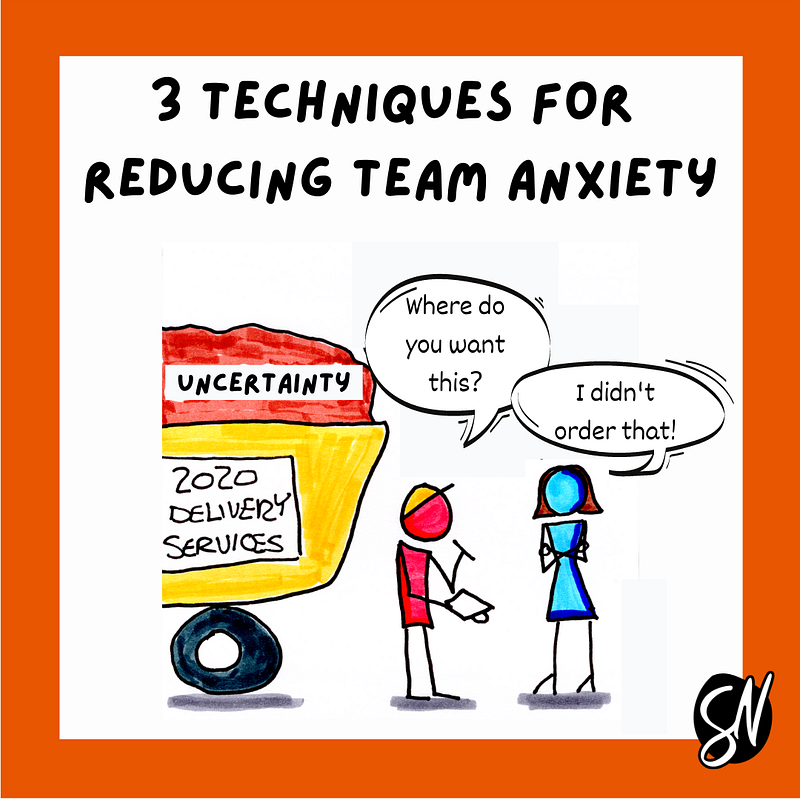
Essentially, anxiety is largely caused by uncertainty. 2020 brought us uncertainty by the truckload. Even if we cannot eliminate the uncertainty, we can mitigate it’s effects by activating other systems in our psyche. Homo Sapiens did not get this far by being unable to deal with the unknown. In fact, there may be some evidence that part of our brain evolved the way it did specifically to handle the unknown. As the only species that can change its behavior without rewiring its DNA, Sapiens have a special advantage when it comes to dealing with the anomalous and unexpected. This is not unique to mammals, even rats demonstrate exploratory behavior, but the pattern of dealing with uncertainty gives us clues as to what is most effective.
One of the most important lessons is that as a social animal, we can help each other cope with uncertainty. What’s more, there appears to be some psychological understructure — what Carl Jung called Archetypes which wire us to be influenced by certain behavior patterns, including leadership. People who can exude a calm, centered, stable persona can help their cohorts cope with uncertainty by reducing the anxiety.
What is Anxiety?
According to Oliver J. Robinson, a neuroscientist and psychologist based at the Institute of Cognitive Neuroscience at University College London, who was interviewed by Vox’s Constance Grady:
Anxiety is normal thing we feel from time to time. Different than Fear — which is contained, anxiety is an adaptive emotion that is designed to help us with uncertainty. Processed by different circuits in the brain, anxiety has a very useful function — it prepares us for fight or flight, but it doesn’t make us fight or flight.
Why?
Because the human nervous system is well adapted to prepare for threat, and opportunity. Times of profound change are also times of tremendous opportunity. Navigating our people through these times starts with getting them into the frame of mind to find those opportunities. The first step is to calm down. As my good friend the late Stephen Fairely Phd once told me,
High emotion equals low intelligence
Amy Cuddy’s Ted Talk introduced the world to the 2-minute power pose, but the real focus of her work is to find ways to improve:
… on our ability to be present, to be effective communicators and connectors, to approach stressful situations with less anxiety and more confidence and to leave these situations with less regret and more satisfaction.
Getting people to calm down can bring more of their mental resources online. I have written about Psychological Safety in other articles, but the idea is the same. When people feel safe(er), more of their mental resources become available. Two systems are largely credited with driving most human feelings, thoughts, and behaviors according to Cuddy — the approach and avoidance systems. Our goal is to activate some of the approach system for our people so they can feel more optimistic, more confident, more creative, and more likely to take action.
How do you do this?
Projecting “Calm”
First, as a leader you want to cultivate an “aura” of calm, centered, stability. According to Robert Moore, Jungian Analyst and Professor of Psychology, Psychoanalysis and Spirituality at the Chicago Theological Seminary, all human beings respond to the idea of leadership that is based upon Jungian Archetypes. By aura, I do not mean a woo-woo field of electrical energy. What I mean is to make use of the 7/38/55 rule of human communication to project calm, centered, stability to the people around you.
What is 7/38/55?
Chris Voss author of never split the difference explains it as the song, music, and dance of human communication. This ratio aligns with Cuddy’s research that body language matters. How we sound, and how we move matters.
A lot.
- 7% of human communication is verbal. (the lyrics)
- 38% is tonal. (the music)
- 55% is body language (the dance).
Unfortunately, we shouldn’t rely on the reverse. Malcolm Gladwell revealed in his book Talking to Strangers, the only way to really know what other people are feeling is to ask them. The most effective way I have found to project calm centeredness is from the ground up. Note: These techniques are most effective if you hold regular — i.e. weekly video conference calls or in person meetings.
The Three Things You Can Do
First, start with your body language. Make sure you feel comfortable and take up space. We spend so much time staring at our phones that most of us are now hunched over and closed off. It’s good to put your back to a wall, or door and press your shoulder blades back. This will open up your chest and expand your lungs. Even standing up and taking a power pose for a few minutes can help.
Second, get your tone right. This has to do with the sound of your voice. I watched Chris Voss completely steer a group of executives simply with the speed and tone of his voice. When he spoke quickly with a lot of energy, everyone was anxious and rattled. When he slowed down, paused a lot, and dropped the tone of his voice — people calmed down and felt like they had time to think. This more than anything will have an impact. Slowing down your cadence, lowering your voice just a tad. I have found it useful to think, “speak in a soothing tone.”
Finally, come the words. Obviously I can’t tell you what to say, but one language tip I have found effective is to eliminate “why” questions from my repertoire. Why? (you see what I did there?) Because why can promote defensiveness. A better way to gain information is to ask, “How” or “What”, or “Tell me…” — open ended questions that draw out more information. These questions also help create the impression that you are paying attention and willing to hear their story. When people feel like they are being understood it can help reduce anxiety. The antidote for anxiety is certainty and control. When we feel more understood, we can relax.
Conclusion
As business guru Joseph Gensler Said:
Leadership not about creating results.
Leadership is about influencing others to create results
And I think influence is the right word here. There is no magic bullet for reducing or eliminating anxiety, but there are simple things leaders can do to either reduce the ambient anxiety or cultivate more of a sense of calm confidence. These techniques are based in the idea of managing the channels human beings naturally communicate with. It’s not just how we say it, it is our tone, and how we carry ourselves. The good news is that many of these techniques are invisible. In my experience people rarely notice these changes consciously, even if they are affected by them.
Your mileage may vary but being mindful of these techniques has helped me and I hope they work for you.
One Aside: Interacting “on the small screen” (Zoom/Meet/Teams/BlueJeans) it is important to know that expressions and emotions are muted. You might actually need to bring your energy UP higher than normal and animate more than you would typically feel comfortable to come across as normal. The single biggest thing you can do however is be aware that your tone and actions have way more impact than your words. Just this awareness will can help you begin to craft your communication style in a more effective direction.